Tutorials
Simplest possible full example
Introduction
To build up a SKG from scratch, you will need at least four files:
some data, for instance in a table:
data.csv,An ontology file, containing the taxonomy of types you want to use:
ontology.ttl.a BioCypher configuration indicating what ontologies to use, and what database to export to:
config.yaml,a mapping, indicating what column of the table to map on which type of the ontology:
mapping.yaml.
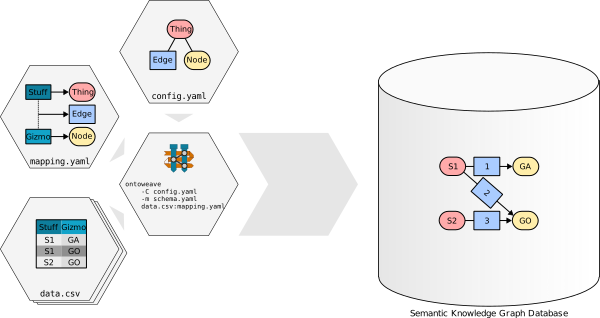
A diagram showcasing the various files needed to configure an OntoWeaver run.
Files
Let’s say we want to extract a graph of 4 nodes and 3 edges from a table with 3 rows and 2 columns, those files would look like the following.
Stuff,Gizmo
S1,GA
S1,GO
S2,GA
@prefix : <https://my.domain.tld/ontology#> .
@prefix owl: <http://www.w3.org/2002/07/owl#> .
@prefix rdfs: <http://www.w3.org/2000/01/rdf-schema#> .
@prefix biocypher: <https://biocypher.org/biocypher#> .

biocypher:BioCypherRoot a rdfs:Class ;
     rdfs:label "BioCypherRoot" .

owl:thing a rdfs:Class ;
    rdfs:label "thing" ; # Note how labels are lowercased.
    rdfs:subClassOf biocypher:BioCypherRoot .

:node a rdfs:Class ;
    rdfs:label "node" ;
    rdfs:subClassOf owl:thing .

:edge a owl:ObjectProperty ;
    rdfs:label "edge" ;
    rdfs:subPropertyOf biocypher:BioCypherRoot .
biocypher:
    dbms: owl # For example, here, we output in an OWL file.

    head_ontology:
        url: tests/simplest_example/ontology.ttl
        root_node: BioCypherRoot

owl: # Options for the chosen OWL DBMS.
    rdf_format: turtle
    edge_model: ObjectProperty
    labels_order: Leaves
    node_labels_order: Leaves
    edge_labels_order: Leaves
row:
    map:
        column: Stuff     # Columns are uppercased.
        to_subject: thing # But types are converted to lowercase as the labels in the ontology.
transformers:
    - map:
        column: Gizmo
        # You can map to any label,
        # as the schema will have the
        # last word on the actual type.
        to_object: node
        # But convention dictates to just
        # use the type, as seen by BioCypher,
        # because this is simpler to understand.
        via_relation: edge
Result
Now, you have to run OntoWeaver, using all those files:
ontoweave -C config.yaml -m schema.yaml data.csv:mapping.yaml
This will print in which directory is the populated OWL file.
The output file should look like this populated OWL file:
ontology.ttl file.# This part is the same as the input ontology:
@prefix : <https://my.domain.tld/ontology#> .
@prefix biocypher: <https://biocypher.org/biocypher#> .
@prefix owl: <http://www.w3.org/2002/07/owl#> .
@prefix rdfs: <http://www.w3.org/2000/01/rdf-schema#> .
owl:thing a rdfs:Class ;
rdfs:label "thing" ;
rdfs:subClassOf biocypher:BioCypherRoot .
biocypher:BioCypherRoot a rdfs:Class ;
rdfs:label "BioCypherRoot" .
:node a rdfs:Class ;
rdfs:label "node" ;
rdfs:subClassOf owl:Thing .
:dge a owl:ObjectProperty ;
rdfs:label "edge" ;
rdfs:subPropertyOf biocypher:BioCypherRoot .
# This part contains the actual graph data:
:S1 a owl:NamedIndividual,
owl:hing ;
rdfs:label "S1" ;
biocypher:id "S1" ;
biocypher:preferred_id "id" ;
:edge :GA,
:GO .
:S2 a owl:NamedIndividual,
owl:hing ;
rdfs:label "S2" ;
biocypher:id "S2" ;
biocypher:preferred_id "id" ;
:edge :GO .
:GA a owl:NamedIndividual,
biocypher:node ;
rdfs:label "GA" ;
biocypher:id "GA" ;
biocypher:preferred_id "id" .
:GO a owl:NamedIndividual,
biocypher:node ;
rdfs:label "GO" ;
biocypher:id "GO" ;
biocypher:preferred_id "id" .
Fully fledged demo
This tutorial tries to show as much as possible of OntoWeaver’s features, with all explanations inserted as comments in the actual files.
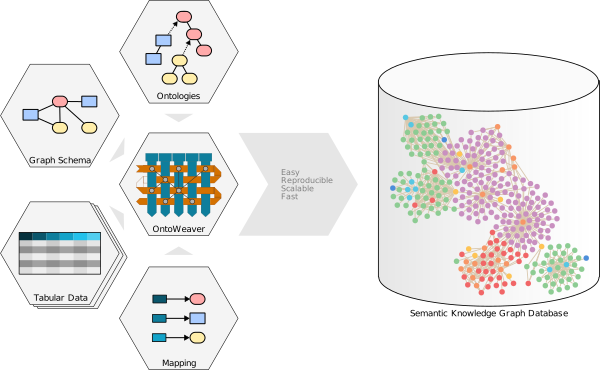
Diagram showing that OntoWeaver needs ontologies, tabular data and graph schema to produce a Semantic Knowledge Graph.
Input files
Those files are usually provided by someone else, and you want to use them.
Patient,Sample_location,Sample_ID,Gene,Type,Location,Impact,Metadata,Sources
Albert,Liver,1,brca1,SNP,Chr1_23_A>G,Oncogenic,"{""ref"":""A"", ""date"":""2026-02-15""}","Pubmed:12345,DOI:abc_123"
Albert,Liver,2,brca2,SNP,Chr2_34_G>C,Likely oncogenic,"{""ref"":""B"", ""date"":""2026-02-15""}",
Albert,Liver,3,CLOCK,SNP,Chr4_56_A>C,Not oncogenic,"{""ref"":""A"", ""date"":""2026-02-15""}",Pubmed:9876
Josette,Prostate,1,brca2,CNV,Chr2,Likely oncogenic,"{""ref"":""C"", ""date"":""2026-02-15""}",DOI:azr_987
Josette,Prostate,2,brca2,SNP,Chr2_34_G>C,Likely oncogenic,"{""ref"":""C"", ""date"":""2026-02-15""}","DOI:abc_123,Pubmed:9876"
Which encodes the following table:
Patient |
Sample_location |
Sample_ID |
Gene |
Type |
Location |
Impact |
Metadata |
Sources |
|---|---|---|---|---|---|---|---|---|
Albert |
Liver |
1 |
brca1 |
SNP |
Chr1_23_A>G |
Oncogenic |
{“ref”:”A”, “date”:”2026-02-15”} |
Pubmed:12345,DOI:abc_123 |
Albert |
Liver |
2 |
brca2 |
SNP |
Chr2_34_G>C |
Likely oncogenic |
{“ref”:”B”, “date”:”2026-02-15”} |
|
Albert |
Liver |
3 |
CLOCK |
SNP |
Chr4_56_A>C |
Not oncogenic |
{“ref”:”A”, “date”:”2026-02-15”} |
Pubmed:9876 |
Josette |
Prostate |
1 |
brca2 |
CNV |
Chr2 |
Likely oncogenic |
{“ref”:”C”, “date”:”2026-02-15”} |
DOI:azr_987 |
Josette |
Prostate |
2 |
brca2 |
SNP |
Chr2_34_G>C |
Likely oncogenic |
{“ref”:”C”, “date”:”2026-02-15”} |
DOI:abc_123,Pubmed:9876 |
# Namespaces:

@prefix : <https://my.domain.tld/ontology#> .
@prefix owl: <http://www.w3.org/2002/07/owl#> .
@prefix rdfs: <http://www.w3.org/2000/01/rdf-schema#> .
@prefix biocypher: <https://biocypher.org/biocypher#> .

#######################################################
# The "taxonomy" part of the ontology
# (sometimes called the "vocabulary")
#######################################################

# We need a base root to which to attach all types.
# Because we allow to assemble type hierarchy trees.
biocypher:BioCypherRoot a rdfs:Class ; # `a` means the same than `rdf:type`.
     rdfs:label "BioCypherRoot" . # We need label on ALL types. Do not forget them.

# Classical types, serving ase bases.

owl:thing a rdfs:Class ; # Type for nodes.
    rdfs:label "thing" ; # Note how labels are lowercased.
    rdfs:subClassOf biocypher:BioCypherRoot . # `subClassOf` means the same than `is_a`.

:association a owl:ObjectProperty ; # Type for edges.
    rdfs:label "association" ;
    rdfs:subPropertyOf biocypher:BioCypherRoot . # We need to attach object properties to the root node.

# Our own node types, inheriting from the others:

:patient a rdfs:Class ; # a Class = is a typed node.
    rdfs:label "patient" ;
    rdfs:subClassOf owl:thing . # Inherits from thing = is a node.

:sample a rdfs:Class ;
    rdfs:label "sample" ;
    rdfs:subClassOf owl:thing .

:gene a rdfs:Class ;
    rdfs:label "gene" ;
    rdfs:subClassOf owl:thing .

:alteration a rdfs:Class ;
    rdfs:label "alteration" ;
    rdfs:subClassOf owl:thing .

:publication a rdfs:Class ;
    rdfs:label "publication" ;
    rdfs:subClassOf owl:thing .

:effect a rdfs:Class ;
    rdfs:label "effect" ;
    rdfs:subClassOf owl:thing .

# Our own edge types:

:insample a owl:ObjectProperty ;
    rdfs:label "insample" ;
    rdfs:subPropertyOf :association .

:hasalteration a owl:ObjectProperty ;
    rdfs:label "hasalteration" ;
    rdfs:subPropertyOf :association .

:ongene a owl:ObjectProperty ;
    rdfs:label "ongene" ;
    rdfs:subPropertyOf :association .

:knownhas a owl:ObjectProperty ;
    rdfs:label "knownhas" ;
    rdfs:subPropertyOf :association .

:publishedin a owl:ObjectProperty ;
    rdfs:label "publishedin" ;
    rdfs:subPropertyOf :association .

:knownas a owl:ObjectProperty ;
    rdfs:label "knownas" ;
    rdfs:subPropertyOf :association .
Config files
Those are the files you are supposed to write: the schema, the mapping and the config.
# This "schema*"file mainly serves to define what types you are using.
# In the simplest case (like here), it allows to *extend* the ontology.

# We want to manually extend the taxonomy,
# without touching to the ontology file
# (which may be maintained by some other expert).

mutation: # Add this class...
    is_a: alteration # ... as a subClassOf this one.

copyNumberVariation:
    is_a: alteration

# We could have defined a lot more things here (see BioCyoher's documentation),
# but we will let OntoWeaver automatically extend this schema to a complete one.
# This "mapping" file is the most important configuration for OntoWeaver.
# It is the one defining what to map on which node or edge.

row: # Each row of the data represents and object of interest: a node.
    cat_format: # We assemble an identifier by using several columns.
        columns:
            - Gene
            - Type
            - Location
        format_string: "{Gene}_{Type}_{Location}" # Following Python standard with column names.
        match: # Assign a different type, depending on the ID value.
            - SNP: # If the assembled ID contains "SNP".
                to_subject: mutation # The "subject" is the type of the "row" node.
            - .*CNV.*: # Another way to encode "contains CNV" as a regular expression.
                to_subject: copyNumberVariation

transformers: # Now that we have a subject, we will link other nodes to it.
    - map: # Take the cell value and make it a node.
        column: Patient
        to_object: patient # The type of the node that's linked to the subject node.
        via_relation: hasalteration # The edge type.

    - cat: # An even simpler concatenation.
        columns:
            - Sample_location
            - Sample_ID
        to_object: sample
        via_relation: insample

    - upper: # `map` with a change of case.
        column: Gene
        to_object: gene
        via_relation: ongene

    - map:
        column: Impact
        from_subject: gene # You can create edges from a node that's node the subject.
        to_object: effect # Types may be different from the column name.
        via_relation: knownas

    - map:
        column: Impact # You can re-use any columns several times.
        to_property: oncogenicity # Creates a key-value pair {"oncogenicity": <cell value>}...
        for_object: gene # ... attached to nodes of type "Gene".

    - replace:
        column: Location # You can use the same colum in several transformers.
        to_property: locations
        for_object: gene
        forbidden: "_"  # Remove this regular expression...
        substitute: ":" # ... and replace matching strings with this one.

    - nested:
        keys:
            - Metadata # The column.
            - ref # The key within the JSON object.
        to_property: reference
        for_object: has_alteration # You can attach properties to edges. FIXME

    - nested:
        keys:
            - Metadata
            - date
        to_property: date
        for_object: sample # Even if this comes from the same column, this can be attached to separated objects.

    - split: # Split the cell content and create as many nodes of the same type as it contains items.
        column: Sources
        to_object: publication
        via_relation: publishedin
# This "config" file indicates how to assemble your taxonomy,
# and in which format to export the produced graph.

biocypher:
    dbms: owl  # This will output an ontology file.
    head_ontology:
        url: tests/full_fledge_demo/ontology.ttl # The file above, your path may vary.
        root_node: BioCypherRoot

owl:
    edge_model: ObjectProperty # A classical OWL ontology.
    file_format: turtle # A format readable by humans (the one used above).
    labels_order: Leaves
    node_labels_order: Leaves
    edge_labels_order: Leaves
Run ontoweave
To run OntoWeaver and weave those data into a semantic knowledge graph, use the following command:
ontoweave --biocypher-config demo_config.yaml --auto-schema extended_schema.yaml --auto-schema-overwrite --biocypher-schema demo_schema.yaml demo_data.csv:demo_mapping.yaml
Expected output file
:publication a rdfs:Class ;
    rdfs:label "publication" ;
    rdfs:subClassOf owl:thing .

:sample a rdfs:Class ;
    rdfs:label "sample" ;
    rdfs:subClassOf owl:thing .

:CLOCK_SNP_Chr4_56_A%3EC a owl:NamedIndividual,
        biocypher:Mutation ;
    rdfs:label "CLOCK_SNP_Chr4_56_A>C" ;
    biocypher:id "CLOCK_SNP_Chr4_56_A>C" ;
    biocypher:preferred_id "id" ;
    :hasalteration :Albert ;
    :insample :Liver3 ;
    :ongene :clock ;
    :publishedin :Pubmed%3A9876 .

:brca1_SNP_Chr1_23_A%3EG a owl:NamedIndividual,
        biocypher:Mutation ;
    rdfs:label "brca1_SNP_Chr1_23_A>G" ;
    biocypher:id "brca1_SNP_Chr1_23_A>G" ;
    biocypher:preferred_id "id" ;
    :hasalteration :Albert ;
    :insample :Liver1 ;
    :ongene :brca1 ;
    :publishedin :Pubmed%3A12345%2CDOI%3Aabc_123 .

:brca2_CNV_Chr2 a owl:NamedIndividual,
        biocypher:CopyNumberVariation ;
    rdfs:label "brca2_CNV_Chr2" ;
    biocypher:id "brca2_CNV_Chr2" ;
    biocypher:preferred_id "id" ;
    :hasalteration :Josette ;
    :insample :Prostate1 ;
    :ongene :brca2 ;
    :publishedin :DOI%3Aazr_987 .

:brca2_SNP_Chr2_34_G%3EC a owl:NamedIndividual,
        biocypher:Mutation ;
    rdfs:label "brca2_SNP_Chr2_34_G>C" ;
    biocypher:id "brca2_SNP_Chr2_34_G>C" ;
    biocypher:preferred_id "id" ;
    :hasalteration :Albert,
        :Josette ;
    :insample :Liver2,
        :Prostate2 ;
    :ongene :brca2 ;
    :publishedin :DOI%3Aabc_123%2CPubmed%3A9876 .

:hasalteration a owl:ObjectProperty ;
    rdfs:label "hasalteration" ;
    rdfs:sub@prefix : <https://my.domain.tld/ontology#> .
@prefix biocypher: <https://biocypher.org/biocypher#> .
@prefix owl: <http://www.w3.org/2002/07/owl#> .
@prefix rdfs: <http://www.w3.org/2000/01/rdf-schema#> .
@prefix xsd: <http://www.w3.org/2001/XMLSchema#> .

owl:thing a rdfs:Class ;
    rdfs:label "thing" ;
    rdfs:subClassOf biocypher:BioCypherRoot .

biocypher:BioCypherRoot a rdfs:Class ;
    rdfs:label "BioCypherRoot" .

:alteration a rdfs:Class ;
    rdfs:label "alteration" ;
    rdfs:subClassOf owl:thing .

:effect a rdfs:Class ;
    rdfs:label "effect" ;
    rdfs:subClassOf owl:thing .

:gene a rdfs:Class ;
    rdfs:label "gene" ;
    rdfs:subClassOf owl:thing .

:patient a rdfs:Class ;
    rdfs:label "patient" ;
    rdfs:subClassOf owl:thing .

PropertyOf :association .

:insample a owl:ObjectProperty ;
    rdfs:label "insample" ;
    rdfs:subPropertyOf :association .

:knownas a owl:ObjectProperty ;
    rdfs:label "knownas" ;
    rdfs:subPropertyOf :association .

:knownhas a owl:ObjectProperty ;
    rdfs:label "knownhas" ;
    rdfs:subPropertyOf :association .

:ongene a owl:ObjectProperty ;
    rdfs:label "ongene" ;
    rdfs:subPropertyOf :association .

:publishedin a owl:ObjectProperty ;
    rdfs:label "publishedin" ;
    rdfs:subPropertyOf :association .

biocypher:CopyNumberVariation a biocypher:Alteration .

:DOI%3Aabc_123%2CPubmed%3A9876 a owl:NamedIndividual,
        biocypher:Publication ;
    rdfs:label "DOI:abc_123,Pubmed:9876" ;
    biocypher:id "DOI:abc_123,Pubmed:9876" ;
    biocypher:preferred_id "id" .

:DOI%3Aazr_987 a owl:NamedIndividual,
        biocypher:Publication ;
    rdfs:label "DOI:azr_987" ;
    biocypher:id "DOI:azr_987" ;
    biocypher:preferred_id "id" .

<https://my.domain.tld/ontology#Likely+oncogenic> a owl:NamedIndividual,
        biocypher:Effect ;
    rdfs:label "Likely oncogenic" ;
    biocypher:id "Likely oncogenic" ;
    biocypher:preferred_id "id" .

:Liver1 a owl:NamedIndividual,
        biocypher:Sample ;
    rdfs:label "Liver1" ;
    xsd:date "2026-02-15" ;
    biocypher:id "Liver1" ;
    biocypher:preferred_id "id" .

:Liver2 a owl:NamedIndividual,
        biocypher:Sample ;
    rdfs:label "Liver2" ;
    xsd:date "2026-02-15" ;
    biocypher:id "Liver2" ;
    biocypher:preferred_id "id" .

:Liver3 a owl:NamedIndividual,
        biocypher:Sample ;
    rdfs:label "Liver3" ;
    xsd:date "2026-02-15" ;
    biocypher:id "Liver3" ;
    biocypher:preferred_id "id" .

<https://my.domain.tld/ontology#Not+oncogenic> a owl:NamedIndividual,
        biocypher:Effect ;
    rdfs:label "Not oncogenic" ;
    biocypher:id "Not oncogenic" ;
    biocypher:preferred_id "id" .

:Oncogenic a owl:NamedIndividual,
        biocypher:Effect ;
    rdfs:label "Oncogenic" ;
    biocypher:id "Oncogenic" ;
    biocypher:preferred_id "id" .

:Prostate1 a owl:NamedIndividual,
        biocypher:Sample ;
    rdfs:label "Prostate1" ;
    xsd:date "2026-02-15" ;
    biocypher:id "Prostate1" ;
    biocypher:preferred_id "id" .

:Prostate2 a owl:NamedIndividual,
        biocypher:Sample ;
    rdfs:label "Prostate2" ;
    xsd:date "2026-02-15" ;
    biocypher:id "Prostate2" ;
    biocypher:preferred_id "id" .

:Pubmed%3A12345%2CDOI%3Aabc_123 a owl:NamedIndividual,
        biocypher:Publication ;
    rdfs:label "Pubmed:12345,DOI:abc_123" ;
    biocypher:id "Pubmed:12345,DOI:abc_123" ;
    biocypher:preferred_id "id" .

:Pubmed%3A9876 a owl:NamedIndividual,
        biocypher:Publication ;
    rdfs:label "Pubmed:9876" ;
    biocypher:id "Pubmed:9876" ;
    biocypher:preferred_id "id" .

:brca1 a owl:NamedIndividual,
        biocypher:Gene ;
    rdfs:label "brca1" ;
    biocypher:id "brca1" ;
    biocypher:locations "Chr1:23:A>G" ;
    biocypher:oncogenicity "Oncogenic" ;
    biocypher:preferred_id "id" ;
    :knownas :Oncogenic .

:clock a owl:NamedIndividual,
        biocypher:Gene ;
    rdfs:label "clock" ;
    biocypher:id "clock" ;
    biocypher:locations "Chr4:56:A>C" ;
    biocypher:oncogenicity "Not oncogenic" ;
    biocypher:preferred_id "id" ;
    :knownas <https://my.domain.tld/ontology#Not+oncogenic> .

biocypher:Alteration a biocypher:Thing .

biocypher:Patient a biocypher:Thing .

:Josette a owl:NamedIndividual,
        biocypher:Patient ;
    rdfs:label "Josette" ;
    biocypher:id "Josette" ;
    biocypher:preferred_id "id" .

:brca2 a owl:NamedIndividual,
        biocypher:Gene ;
    rdfs:label "brca2" ;
    biocypher:id "brca2" ;
    biocypher:locations "Chr2;Chr2:34:G>C" ;
    biocypher:oncogenicity "Likely oncogenic" ;
    biocypher:preferred_id "id" ;
    :knownas <https://my.domain.tld/ontology#Likely+oncogenic> .

biocypher:Effect a biocypher:Thing .

biocypher:Gene a biocypher:Thing .

biocypher:Mutation a biocypher:Alteration .

:Albert a owl:NamedIndividual,
        biocypher:Patient ;
    rdfs:label "Albert" ;
    biocypher:id "Albert" ;
    biocypher:preferred_id "id" .

biocypher:Publication a biocypher:Thing .

biocypher:Sample a biocypher:Thing .

biocypher:Thing a biocypher:BioCypherRoot .

:association a owl:ObjectProperty ;
    rdfs:label "association" ;
    rdfs:subPropertyOf biocypher:BioCypherRoot .