Basics of Semantic Knowledge Graphs
If you wonder how to build a Semantic Knowledge Graph (with OntoWeaver), chances are that you already know what it is. But if you are a newcomer sent here by someone who knows but don’t have the time to explain, this section is for you.
Caution
This introduction targets explaining the bare minimum to understand what OntoWeaver is doing. It avoids a lot of the theory and practice of the related scientific fields, like graph theory or semantic web.
What is a Graph?
A graph is a data structure consisting of a set of objects where some pairs of the objects are in some sense “related”. The objects are represented by abstractions called “vertices” (also called “nodes”) and the link between each of the related pairs of vertices is called an “edge”.
When showed on a diagram, a graph is depicted as a set of circles (the nodes), some of which are joined by lines (the edges). Classicaly, nodes are shown with a text identifier (their “name”, or “ID”), but edges are not (albeit they may have one ID).
Here is a graph of diseases and drugs, for instance:
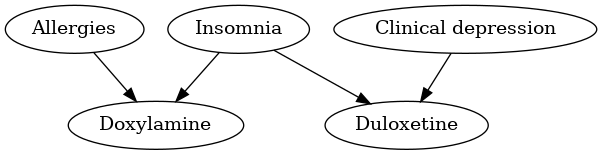
A diagram figuring a graph.
In most cases, nodes are represented as circles. When programming, they are
often represented by parentheses, e.g. (Insomnia) -> (Doxylamine).
What is a Knowledge Graph?
A knowledge graph (KG) is a graph that carries data on its nodes and edges. For instance, nodes and labels can carry a “label” that represents their type, or any data property that means something.
Below is our graph of diseases and drugs, which shows the type of its nodes and edges, along with the IDs of its nodes. Note that any kind of property can be attached to a knowledge graph element, like the “form” one, attached here to the drug nodes:
![digraph {
fontname="Courier New"
Doxylamine [label="Doxylamine\ntype:drug\nform:pills"]
Duloxetine [label="Duloxetine\ntype:drug\nform:pills"]
Insomnia [label="Insomnia\ntype:disease"]
Allergies [label="Allergies\ntype:disease"]
Depression [label="Clinical depression\ntype:disease"]
Insomnia -> Doxylamine [label="type:treatable_by"]
Allergies -> Doxylamine [label="type:treatable_by"]
Insomnia -> Duloxetine [label="type:treatable_by"]
Depression -> Duloxetine [label="type:treatable_by"]
}](../_images/graphviz-59f3332d82288437e0431d08535762da194140fa.png)
A diagram figuring a knowledge graph.
Such a graph with properties attached to its elements is sometime called a “property graph”.
When programming, we often see representations like:
(Insomnia:disease)--[:treatable_by]->(Doxylamine:disease).
What is a Semantic Knowledge Graph?
A semantic knowledge graph (SKG) is a knowledge graph that works with a voccabulary. The vocabulary if made of a “taxonomy” of types (sometimes called “classes”) and a set of properties associated to each type.
The taxonomy is a hierarchical data structure (often a “tree”) that represents types of increasing abstraction. The hierarchical structure defines a (sometimes partial) order among the set of types.
The set of properties associated to a type defines the intrinsic properties that an object has when it belongs to this type (class).
For instance, an “insomnia” is a kind of “sleep disorder”, which in turn is a sub-type of “disease”. Taxonomies are classically represented the same way than a directory tree is shown in your everyday files manager, or a nested bullet list:
thing
├─ entity
│  ├─ Drug
│  │  ├─ Antihistamines
│  │  └─ SNRI
│  └─ Disease
│     ├─ Sleep disorder
│     ├─ Immune response disorder
│     └─ Mental disorder
└─ association
   └─ sensible_to
      └─ treatable_by
In an SKG, it is possible to have a single taxonomy defining types for both nodes and edges.
![digraph {
fontname="Courier New"
Doxylamine [label="Doxylamine\ntype:\l thing\l └ entity\l └ Drug\l └ Antihistamines\nform:pills"]
Duloxetine [label="Duloxetine\ntype:\l thing\l └ entity\l └ Drug\l └ SNRI\nform:pills"]
Insomnia [label="Insomnia\ntype:\l thing\l └ entity\l └ Disease\l └ Sleep disorder"]
Allergies [label="Allergies\ntype:\l thing\l └ entity\l └ Disease\l └ Immune response disorder"]
Depression [label="Clinical depression\ntype:\l entity\l └ entity\l └ Disease\l └ Mental disorder"]
Insomnia -> Doxylamine [label="type:\l thing\l └ association\l └ sensible_to\l └ treatable_by"]
Allergies -> Doxylamine [label="type:\l thing\l └ association\l └ sensible_to\l └ treatable_by"]
Insomnia -> Duloxetine [label="type:\l thing\l └ association\l └ sensible_to"]
Depression -> Duloxetine [label="type:\l thing\l └ association\l └ sensible_to\l └ treatable_by"]
}](../_images/graphviz-2e44afa08f4b02d12da05c4fdeda22ee6e79f779.png)
A diagram figuring a semantic knowledge graph.
Note that the graph elements carry all their “parent” types, along with the
“terminal” type (sometime called “leaf type”, in reference to the taxonomy
being a hierarchy). Nodes and edges may have properties, usually in the
form of key:value pairs (like form:pills here).
Why do we want SKGs?
Tip
Semantic Knowledge Graphs are a way to represent and store a set of information in a database that is very flexible, extensible and easy to query.
You may already know that there are several types of databases, among which the “relational databases” are the most pervasive. In a relational database, objects of interests are represented as rows in tables, and some columns serves as “index” that links tables.
In a way, rows are like nodes, and index are like edges, while other columns are like properties.
Note
Theroretically, you can represent the exact same database in both paradigms, without losing any information. However, one may be more or less intuitive for you to use in your specific context.
Explaining all the pros and cons of SKG against relational databases is beyond the scope, but here are elements supporting why an SKG would be a better choice for you than a relational database:
SKGs are more intuitive for representing some objects, which a human would naturally think as a graph. For instance a collection of things linked in a network, or chains of causal relationships.
Modern SKG engines are as efficient as their relational counterparts.
SKGs are very easy to extend, and adding nodes and/or properties does not drastically change the way you query the data.
Queries can leverage the taxonomy very easily.
Overall, we find queries on SKG to be more easy to state (especially with the GQL language) than their counterpart (using SQL, for instance).
For example, here is a GQL query meaning “show me all the drugs for which there is a sensitivity to a sleep disorder”:
MATCH (s:Sleep disorder)-[:sensitive_to]->(d:Drug) RETURN d.label
And its SQL counterpart:
SELECT d.label FROM Drug d JOIN Disease s ON s.sensitive_to = d.id WHERE s.type LIKE "%Sleep disorder%"
-- Assuming that the "type" columns aggregates all parent types in a string.
And that is just for a simple query.
Where can I get taxonomies for my SKG?
The first community to have produced tools around this idea of graphs carrying structured data gravitates around the idea of “semantic web”. As such, several of their tools became some kind of standard. That’s the case of “ontologies”.
Nowadays, most of the useful taxonomies thus come in the form of ontology files.
What is an Ontology?
If we restrict its definition to the use made in computer science, an ontology is generally a file, carrying both a vocabulary (both the “taxonomy” and the set of “properties”) and an SKG (a “populated graph”). Less often, it also carry a set of logical predicates modelling constraints, for instance about what type of node can be connected to what other type of node.
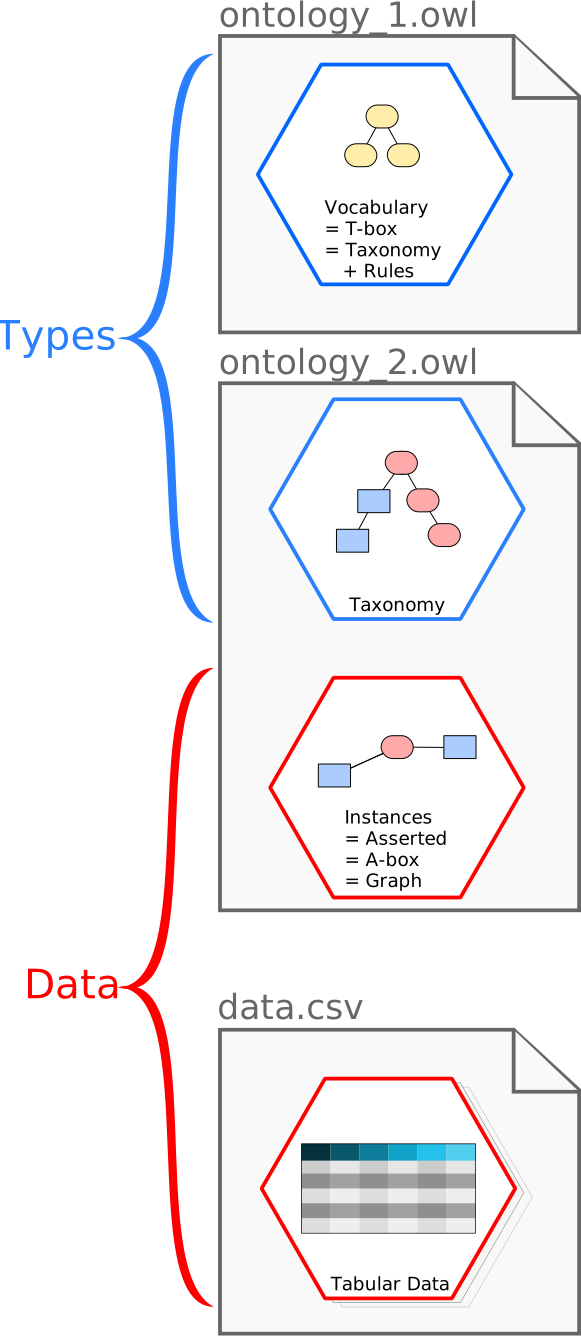
Ontology files can contain a taxonomy (and thus “types”, in blue), and an SKG (and thus “data”, in red).
To do so, an ontology file is taking a very generic approach: everything there
is modelled as a “triple”: a (subject) is linked by a [predicate] to an (object).
This means that everything in an ontology is represented by:
(subject)--[predicate]->(object). Nodes are subjects or objects, edges are
predicates. But “node having a type” is also represented as a triple:
(my node)--[is a]->(my type).
What is Turtle?
There are several formats with different syntaxes to write down ontology files, but we will only see here the “turtle” one, which is the most readable by a human being. In turtle, a triple is written as a “sentence”:
# The dot indicate the end of the sentence.
subject predicate object .
Turtle also provides a short syntax to apply several predicate to the same subject:
subject predicate1 object1 ;  # The semicolon indicate a part of the sentence.
        predicate2 object2 .
For instance, this is a valid turtle section:
my_node a my_disease ;  # "a" meaning "is a".
        label "My Node" .  # "label" having some pre-defined meaning.
What is OWL?
OWL is a —slightly eccentric— accronym for “Web Ontology Language”. The “language” it refers to is a pre-defined set of predicates and types (hence the term “vocabulary”). This language defines how to model a SKG, using a standardized vocabulary on which everyone can agree.
But in fact, OWL is built up on top of two other standards:
the Resource Description Framework (RDF),
the RDF Schema (RDFS).
Of course, RDFS is a vocabulary that sits on top of RDF, with a carefully chosen —and not at all confusing— name.
See also
Technically, RDF and RDFS bring a method of modelling, and OWL brings the vocabulary that is necessary for reasoning over “description logics”. Reasoning is beyond the scope of this introduction, but it may be useful for users as a way to check the validity of an SKG (e.g. raise an error if a node is linked to too many nodes, or if a node type is illogical), or complete an SKG with missing data (e.g. a missing reverse edge, or a missing “is a” edge toward a class).
There’s a lot theoretical stuff that’s explained in all those specifications, but in a nutshell, here is what each vocabulary is bringing that is of interest for this introduction:
RDF:
rdf:type: a predicate meaning “the subject is a object” In turtle, it can be typed as “a”. This means that the subject is an instance of this type.rdf:Class: a type representing a… type. If you typeDisease a rdf:Class, that means that “Disease” is a type. So that you can typeInsomnia a Disease. But note that “Insomnia” is not a class, it is an instance of the “Disease” class.rdf:Property: a relationship between an instance and either another instance, either an atomic piece of data (i.e. a number or a string). That is a special kind of class, in a way.
RDFS:
rdfs:subClassOf: a predicate necessary for building a taxonomy. That is, a hierarchy of classes.rdfs:subPropertyOf: the predicate for building a taxonomy of property classes.rdfs:label: the textual representation of any subject. That’s necessary, because all subjects are identified by a Universal Resource Identifier (URI, sometimes you will see the old term “IRI”), which is essentially a URL.
OWL:
owl:Thing: the root of all classes in every taxonomies.owl:sameAs: a predicate meaning that the subject is the same as the object.owl:NamedIndividual: an object indicating that the subject is an instance.owl:ObjectProperty: a type for edges linking two nodes.owl:DatatypeProperty: a type of “edge” between a node and a piece of information. Remember that here, everything is a triple.
Warning
There is an easy confusion to make between owl:ObjectProperty and what
we called “properties” in a SKG. Note that an owl:ObjectProperty is
actually akin to an edge. It is owl:DatatypeProperty that is a
property in an SKG.
Note
An “instance” is —more or less— the same as an individual, in the sense that it’s a node carrying some actual information about an object out there, in the real world. OWL calls the set of individual a “population”, for instance, which is the same than what we call an SKG.
In an ontology file, you may find both an SKG and a taxonomy. Semantic web experts sometimes refer to the SKG as the “A-box” (the set of asserted pieces of information), and the taxonomy as the “T-box” (the set of types).
Why do we need OWL?
All these predicates forms a vocabulary that is common to everyone, and allows people to define an ontology for others to use. An ontology is thus first a tool for experts to indicate how a field of interest shoud model its objects.
There are a lot of different ways to model something with OWL. For most of users, the most useful element is the taxonomy.
Important
Note, however, that it always goes with a modelling method, that you may have to learn in order to understand how to split your objects of interests in atomic pieces, and how to apply the taxonomy!
For instance, you will very often face the question: should this information be modelled as a node or as a property? Usually, the people having made the taxonomy that you are using have the answer. Read their documentation!
Why do I need OntoWeaver to make an SKG?
OntoWeaver is a tool that shines if you need to build up an SKG that:
is integrating several heterogeneous data sources,
is automatically built, in a reproducible way,
allows using independent data sources, for which import scripts and taxonomies have been made by other people,
allows fine-grained configuration.
If you feel those features are necessary for your use-case, read the remaining sections of this documentation!